The Bawwab's Daughter

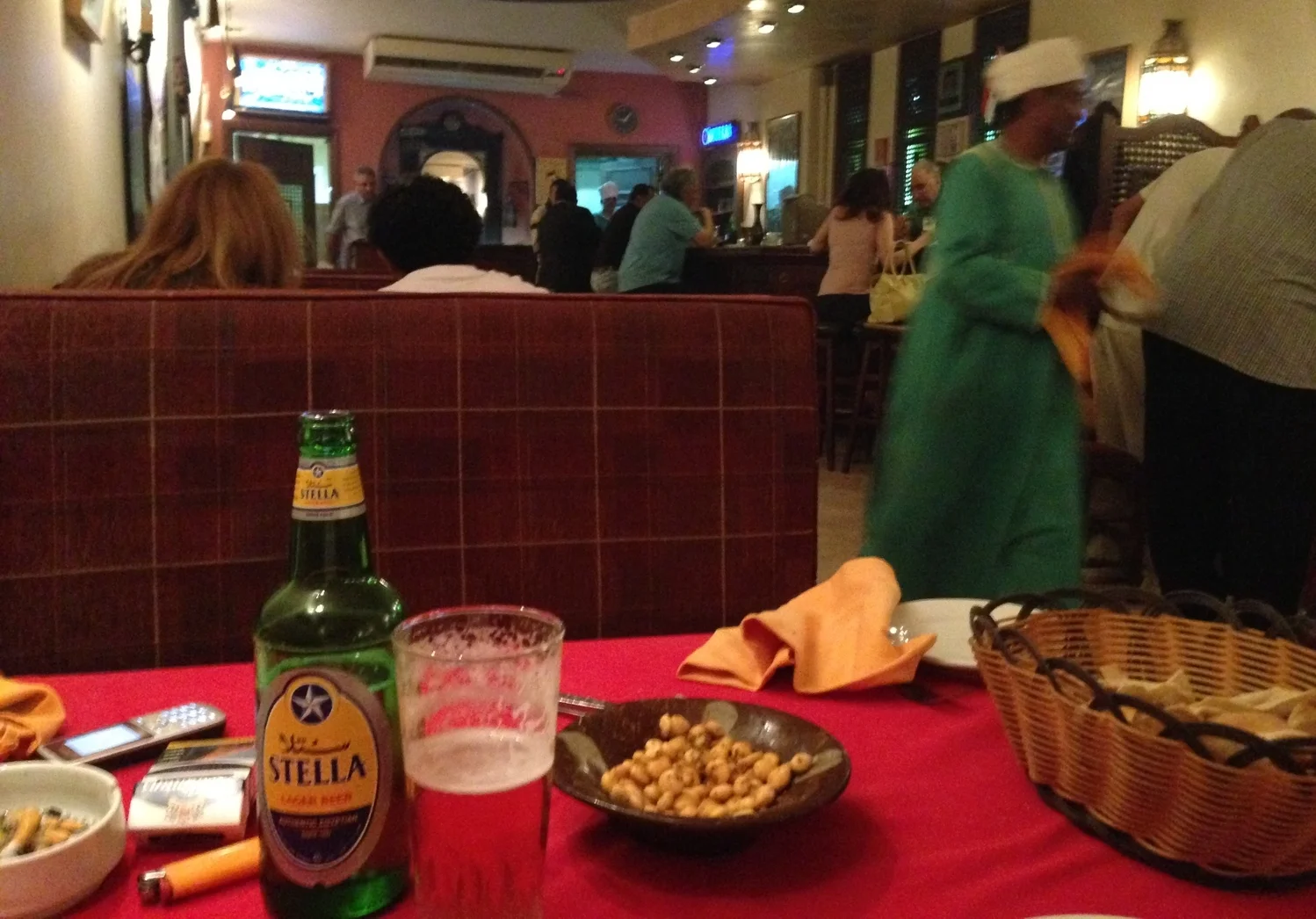
I was staying with friends in Maadi, a noisy, dusty suburb south of Cairo. One of the most striking features of this neighborhood — actually its own city — is that many of the expats who live there persevere in the spurious claim that it is quieter and greener than the neighborhoods of the city center. In any case, there is no dispute about this: Maadi is far away from the city center and, unlike Cairo, no one would travel hundreds of miles just  to visit it. Despite my strong objections to the place, I was enjoying myself with my friends, sleeping late, staying up late on their terrace, smoking cigarettes and talking about how our lives were changing as we entered middle age. It helped that their beautiful child was often there to gleefully punctuate our conversation or to deflect it into gentler, brighter directions. It was not hard to forget that the country was in the midst of a revolution.

While I was staying there, I spent much of my time thinking about the past and comparing the present to before January 25. And then comparing everyone and everything — friendships, buildings, streets, music, food, air temperature — to how I remembered them to be 3 years, 5 years, 10 years, even 20 years before. I know it is wrong to judge current experiences by past ones. Invariably, the comparison is not generous and gets in the way of experiencing the present as it is. Yet, I found myself engaging in this behavior despite myself. I walked through city with a camera to record the changes. I talked with friends, and heard their stories about the revolution. I wrote these down and looked at the photographs and considered how malleable a city of concrete and flesh could be when time does its work. Though I considered some of these changes to be improvements, most seemed to be a loss: gone were the tram lines, one of the last urban links to the 1919 Revolution; gone was the Friday market in Imbaba with its incomparable displays and bargains; gone were some friends — this one emigrated to Spain (still owing me money), that one dead from lung cancer in his mid-40s. His death affected me more than I thought it would: I had no friend here who loved me more than him. (Read More)

Locations

We chose the hamlet of Beit Jeez in from the hundreds of Palestinian villages that were cleansed in 1948. Maryam was scouting locations for her film, and she was looking for a ’48 village where one scene in particular needed to be shot. It was the scene where the protagonist and his girlfriend go after robbing the bank, the place they hole up while they decide whether to continue going on with their crime spree, or to leave for good. It was important that it take place in the ruins of a ’48 village.

Her travels had taken her all around, from the areas around Umm al-Fahim in the triangle, to old villages in the plain between Acre and Haifa, to even the upper Galilee, to old hilltop villages overlooking the south of Lebanon. Once, in the village of Bir‘im where a Maronite church still stood partly intact, she’d found a group of women sitting, looking off into the distance. When she spoke to them, she realized from their accent that they were Lebanese. Talking with them, she found out they’d come with their families in 2000 when the Israeli occupation came to an end and could probably never go back. Now, they said, they lived in a nearby Palestinian Israeli village where no women would speak to them and where their husbands could find no work, not even with the IDF. The rest of their families lived in Jewish cities like Nahariya and Safad where they felt even more miserable and isolated. Many had already returned, though who knows what would be in store for those who did.

They often hitched a ride to the place on Fridays where they sat picnicking until sunset. They offered Maryam apples and sweet tea the day she was there. While she sat with them, they pointed out Mt. Meron, Mt. Hermon, the Golan, and even the faintest traces of the Shuf Mountains far to the North. Unfortunately, as compelling as these locations were, they didn’t feel right for the film. Maryam had so far had already seen more than 50 locations, she’d know the right one when it came along. (Read More)

Howl

Considering the fact that our literature workshop at Birzeit almost didn’t take place at all, it was a real success. We’d applied for a grant to teach a workshop to Palestinian university students through a fund administered by the US Department of Education and the State Department’s Public Diplomacy program. Despite the contacts that the consul in East Jerusalem had set up with our colleagues at Birzeit, we had a difficult time making arrangements. The department chair was away for the summer and didn’t respond to our emails as we tried to confirm our plan. Fortunately, David knew some people in other departments who connected us to Ahlam, a junior member of the English faculty. It turned out to be a perfect match—she was enthusiastic to have us come and meet with her students. She’d studied English modernism in America on a Fulbright. If she hadn’t drummed up support for us, I doubt it would have happened.

We finally figured out a time that would work for all of us, though when it came, it turned out to be the same day that an American diplomat was visiting Ramallah and the whole place was shut down for a general strike in protest. We told our driver that we wanted to go anyway.

When we arrived, we found two military jeeps parked at the entrance to the university. Students were throwing rocks at the vehicles while soldiers fired rubber bullets back at them. We waited with other cars as the scene unfolded. Then, for no reason, the army sped off with sirens flashing. (Read More)

Lessons in Morphology

It was a strange but mutually beneficial arrangement. I needed to travel north through a number of checkpoints to visit a town that had borne the brunt of the occupation and I needed to get back to Ramallah at a decent hour so as to see friends before I left the next day. They had a service taxi for hire, but little business and few customers. I hired the taxi for a day, and the driver asked if his best friend and his best friend’s son could come along. I said, “The more the merrier.” As we left Ramallah, we passed by the PA’s headquarters, the place where Arafat had been confined for the last three years of his life. They showed me where the prison had been, where the television station was and so on. Much of it was still rubble, even though the Israeli attacks were now years old or more. We left al-Bira and the driver startled me by saying it was good to leave Ramallah. “It belongs to the Tunisians and the Americans who returned to build their villas and play.” He pointed north, offered me a cigarette and said, “Welcome to Palestine.”

This then was to be my “tour” of the occupied territories, and these three, my tour guides. I asked them question after question: What’s that? What’s the name of that village? Where does that dirt road lead to? What kind of trees are those? What kind of grain is that? What’s that building? What’s over there? Why is the asphalt so bad here, why is it better back on the road we were just on? I must have asked hundreds of questions, but my guides did not seem annoyed by them. They got a kick out of my linguistic struggles, I think. For me, it was my first time hearing the dialect of the villages, where, as everyone knows, the letter K disappears to be replaced by a CH sound. Though I came here to tour the landscape of the territories, I was now intrigued their idioms. (Read More)