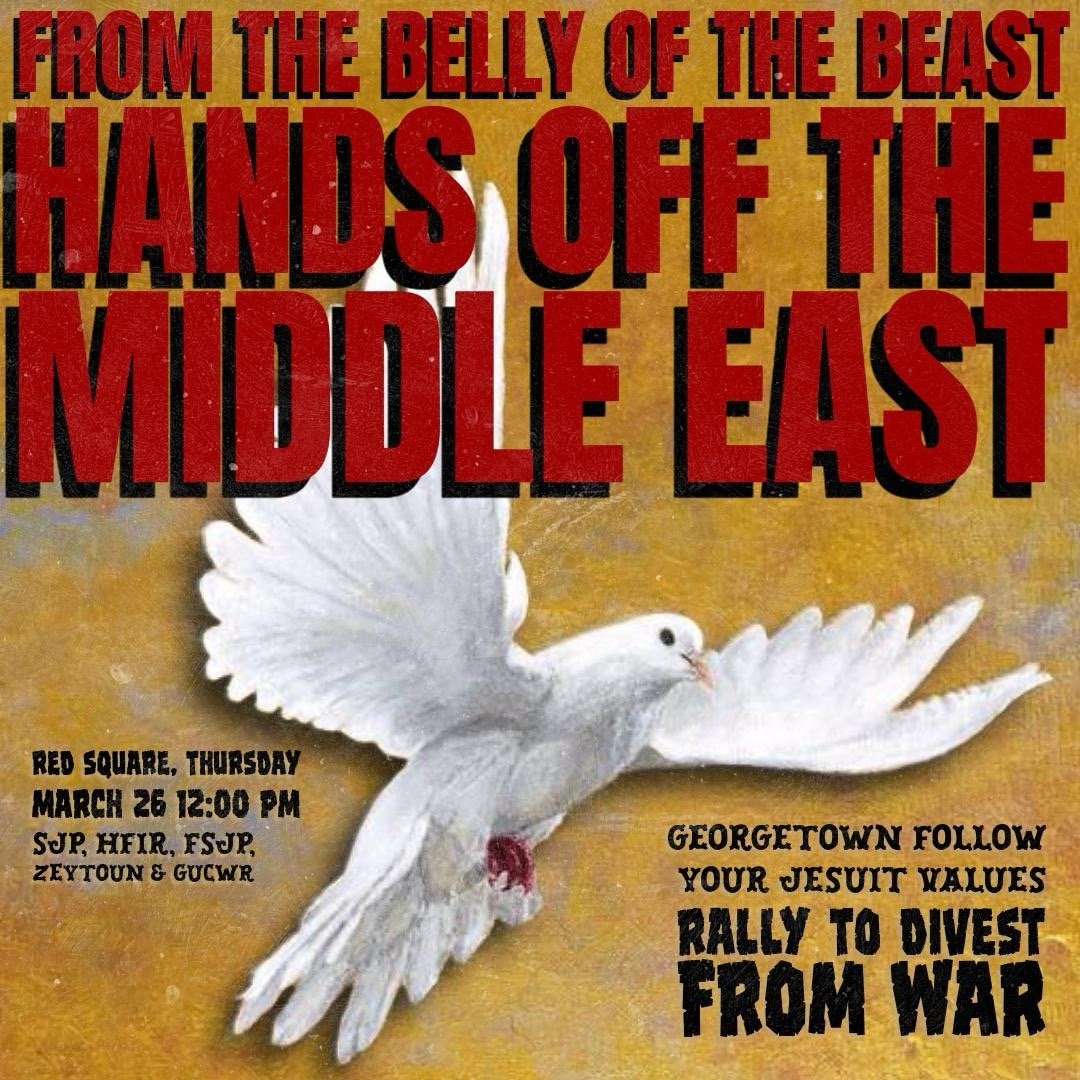
Yesterday, I was proud to stand with activists from Hoyas for Immigrant Rights, the GU Coalition for Workers' Rights, Students for Justice in Palestine, Zeytoun, and Faculty and Staff for Justice in Palestine. We gathered at noon at Red Square on the Georgetown campus and spoke about the many assaults taking place in our world: against immigrants, against workers, against Gaza, Lebanon and Iran. A concerned member of the public attempted to shut down the event, which led to this jovial exchange.
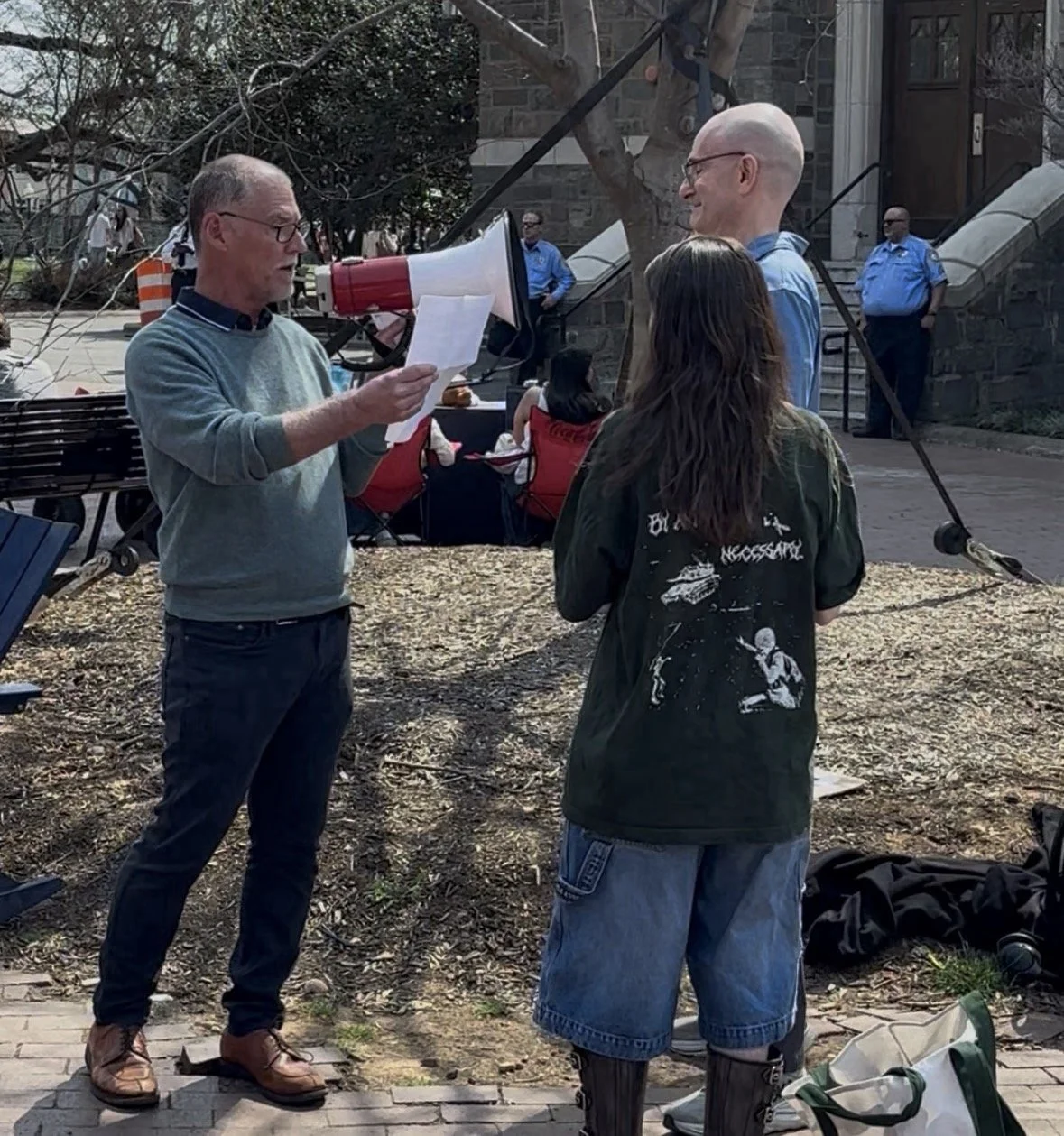
This is the text of the speech I gave:
We are rallying today to protest the US-Israeli wars of aggression, obliteration, and annihilation. Many of us here have been gathering together regularly for the past two and a half years, to express our opposition to Israel’s killing and overkilling in Gaza, and to stand in solidarity with the Palestinians who have survived and resisted that killing campaign. We have gathered numerous times to protest genocide and scholasticide, and to mourn the more than 100,000 Palestinians murdered since October 2023. We have gathered to remind you that last year’s Ceasefire did not end the bloodbath and that each day Israel continues to murder more Gazans. The genocide continues even as Israeli settlers and militias have ramped up the violence throughout the West Bank, in preparation for total annexation.
Initially, it may have been our grief and anger that brought us together, but by now it should be clear: what brings us together, what joins us, what animates us here is our love of life, and our commitment to human rights and justice. We oppose Israeli military occupation and Israeli apartheid and Israeli genocide because we love life and liberty and truth just as we love our fellow humans, whether they are in Washington DC or in Gaza. We are here because of that love — Palestine is just one of the many names we call that love.
Lebanon and Iran are other names for that same love. We’re here again today because of that love, we’re here today to speak out about the American-Israeli attacks on those countries and those fellow human beings. In Iran, more than 1500 civilians have been killed by American and Israeli missiles and bombs, most of them women and children. Another 20,000 Iranians have had their lives permanently altered by serious injuries. More than 3 million Iranians have been displaced because of the violence and destruction. In Lebanon, more than 1000 civilians have been murdered by Israeli attacks, including many many children. Another 2000 have been injured. Over 1 million Lebanese, or one sixth of the total population, have been turned into refugees because of the assault.
That’s a lot of death, injury and suffering. And while it may all seem far away and distant, it is not. In Gaza, the US stood for a while at arms length from the slaughter—we were merely a facilitator of genocide, a supplier of arms and intelligence, a financier of weapons, and a provider of diplomatic cover. But now, we are an active, leading participant in this war. Those are American bombs, missiles, aircraft, and warships converting your parents’ and grandparent’s tax dollars into death and ruination in distant countries. But the business of weapons manufacture, the traffic in arms, the blood profits—all of these are American and will return to enrich a few among us.
Georgetown University is another word for this love that brings us together. We are here because we work here, we study here, we learn here, we teach here. This is our community. And in this community, we admire the Jesuit values on which this university was founded. Because of this love and admiration, is painful to acknowledge that despite the values our leaders espouse, this institution has not been standing on the side of the victims of genocide or apartheid or obliteration.
As an institution, Georgetown gives direct financial support to this war machine through its investments in weapons manufacture and trade. Georgetown gives direct moral support to the perpetrators of genocide — twice in the last two years, Georgetown chaplains, faculty, and students have hosted events celebrating members of Israel’s military who brag about their involvement in wartime atrocities. Meanwhile, some of our colleagues openly advocate for bombing campaigns against Palestine and Iran, others work as apologists for aggression and human rights abuses.
The irony is profound: even as Georgetown censors or reprimands students who advocate for peace and justice, it rewards and celebrates professors who preach bellicosity. There is no sign that this university is about to face its complicity in these illegal assaults. Last year, Georgetown leadership rejected out of hand a student initiative to divest from arms sales to Israel. Last year, the university committee that oversees the ethics of our institution’s investments was persuaded by a stealth Israeli lobby campaign to reject another proposal that sought to bring Georgetown into compliance with Jesuit values. And finally, while Georgetown leaders speak up vociferously to condemn anti-Jewish hate speech, for some reason, they do not know how to do the same when it comes to anti-Muslim, anti-Arab and anti-Palestinian bigotry on this campus. We notice this double standard, and are here to say that it does not make anyone feel safer. We notice that Georgetown does not live up to its slogans, and are here to say that this hypocrisy erodes community solidarity.
This is our university: it has much to love and admire, and also much to condemn. Like at many other universities, there is a struggle here for the heart of our institution. Those of us who believe in the humanity of Gaza or Lebanon or Iran see this struggle very clearly and invite you to join us to make Georgetown a place that lives up to its slogans. This can be a place guided by Jesuit humanist values, or it can be part of the war machine. But it cannot be both.